How to Choose the Best Auto Tint Film for Your Vehicle
Selecting automotive window film is a technical purchasing decision that affects comfort, appearance, visibility, and long-term value. Products that look similar on a showroom display may behave differently under sunlight, during nighttime driving, or after prolonged exposure to heat. Buyers should therefore compare specifications, materials, manufacturing consistency, and installation requirements before choosing an auto tint film.
Aicksn New Materials Technology Co., Ltd. serves the automotive window film market, where distributors and installers need products that combine dependable quality with practical application guidance. Understanding the differences between film types makes it easier to match each product with the right vehicle and customer expectations.
Start with Your Main Performance Requirement
Before comparing brands, identify the primary reason for installing film. Some drivers want greater privacy, while others focus on reducing cabin heat or limiting ultraviolet exposure. Fleet operators may prefer durable, standardized products that simplify maintenance and replenishment.
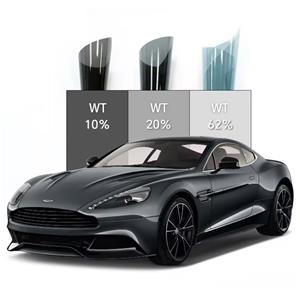
Car window darkening film is often chosen for privacy and styling, but darkness does not automatically indicate strong solar control. A very dark film may reduce visible light without delivering the best infrared rejection. Conversely, a relatively light film may provide useful solar management when it uses an appropriate optical construction.
An effective purchasing process separates visible light transmission, ultraviolet rejection, infrared performance, total solar energy rejection, and glare reduction. These measurements describe different properties and should not be treated as interchangeable.
Buyers should also confirm how each figure was measured. Results can differ depending on the wavelength range, test instrument, glass substrate, and whether the reported value applies to the film alone or the film-and-glass combination.
Understand the Main Film Categories
Dyed film is commonly associated with darker styling and accessible pricing. It may be appropriate for entry-level applications, provided that color stability and optical quality meet the intended service requirements.
Metallic car tint incorporates metallic materials that influence how solar energy interacts with the film. It can offer a reflective appearance and useful solar-control characteristics, depending on the specific formulation. However, some metallic constructions can interfere with electronic signals. Buyers should verify compatibility with GPS, mobile communications, toll collection devices, and other vehicle systems.
A metalized window film is another option for projects that require a particular combination of reflectivity, appearance, and solar performance. Its suitability depends on the actual layer structure and measured specifications. The term alone does not establish a guaranteed level of heat rejection or durability.
Ceramic film uses specialized nonmetallic particles or layers to manage selected solar wavelengths. It is often considered when customers want heat-control performance without a strongly reflective appearance. The cost and performance range can be broad, so comparisons should rely on verified data rather than technology labels alone.
Evaluate Car Window Darkening Film Beyond Its Shade
Car window darkening film should be assessed for color uniformity, optical clarity, surface quality, and resistance to fading. A film with inconsistent coloration can look uneven across the vehicle, particularly when the side windows receive different amounts of sunlight.
Optical haze is another important factor. Excessive haze can make distant objects appear less distinct, while distortion may become noticeable when viewing through curved glass. For this reason, buyers should request representative samples and examine them under indoor lighting, direct sunlight, and nighttime conditions where practical.
Adhesive performance also matters. A well-designed product should remain securely attached when installed according to its instructions. Bubbles, edge lifting, contamination, and premature discoloration can arise from poor materials, unsuitable storage, inadequate preparation, or installation errors. A complete evaluation considers both the film and the installation process.
An auto tint film supplier should provide clear guidance about compatible glass surfaces, recommended installation conditions, curing time, cleaning methods, and warranty limitations.
Choose Windshield Tint Carefully
Windshield tint requires particular attention because the windshield is essential to forward visibility. Before selecting a product, check local laws for permitted film placement, minimum light transmission, reflective properties, and any restrictions on full-windshield applications.
A windshield tint product should provide reliable optical clarity and should not create distracting haze or distortion. Installers must also consider the vehicle's existing glass characteristics, including factory tint, coatings, curvature, and any special sensors mounted near the windshield.
Drivers should never assume that a product is legal simply because it is sold commercially. The same film may be suitable for a side window in one jurisdiction but restricted on a windshield in another. Written compliance information and professional installation advice can help reduce costly mistakes.
What Buyers Should Ask a Manufacturer
A professional supplier should be able to explain the product's construction and provide a technical data sheet. Useful questions include:
What are the measured VLT and optical haze values?
How is infrared rejection defined and measured?
Are the results based on film-only testing or installed glass?
What test methods support the ultraviolet and solar-performance claims?
What are the recommended storage and installation conditions?
How are production lots identified and inspected?
What warranty coverage applies to discoloration, peeling, or other defects?
Aicksn can strengthen its buyer relationships by supplying documented answers supported by current product specifications. If testing is performed by an independent laboratory, the report should identify the sample, method, date, and test conditions.
For metallic car tint and metalized window film, manufacturers should also explain whether signal compatibility has been evaluated. This is especially relevant for vehicles that rely on electronic communication systems.
Manufacturing Quality and Batch Consistency
Film performance depends on more than the design of the product. Raw-material consistency, coating control, cleanliness, winding tension, slitting accuracy, and packaging can all influence the condition of the finished roll.
A practical factory quality plan may include incoming-material verification, in-process visual checks, dimensional inspection, optical measurements, adhesion assessment, and finished-roll inspection. For example, a proposed sampling plan could measure film width at three positions along a roll and compare the results with an approved tolerance. The actual tolerance should be defined by the product specification rather than assumed to be universal.
Accelerated-aging tests may help evaluate color stability, but laboratory exposure does not perfectly reproduce every real-world environment. Test results should therefore be interpreted alongside field experience and warranty data.
Traceability can further improve customer service. Lot numbers, production dates, inspection records, and packaging identification make it easier to investigate reported defects and manage repeat orders.
Match the Product to the Vehicle and Market
A passenger car owner may prioritize appearance and comfort. An SUV owner may seek a balance between rear-seat privacy and nighttime visibility. A commercial fleet may need standardized specifications across hundreds of vehicles. Each application can justify a different film construction and shade.
Car window darkening film should therefore be selected by vehicle position, local regulations, driver needs, and the original glass specification. Auto tint film used on side and rear windows may require a different evaluation from a product intended for the windshield.
Before committing to a large order, distributors should test samples on representative vehicles, review installation feedback, and confirm the packaging format. These steps help prevent mismatches between catalog claims and real-world expectations.
Aicksn New Materials Technology Co., Ltd. can support professional buyers through transparent specifications, repeatable production controls, and clear communication about product limitations. By evaluating metallic car tint, windshield tint, and metalized window film against consistent criteria, buyers can make better-informed decisions and build a more reliable automotive film offering.