5-Window Tint: Installation, Coverage, and Performance Guide
A 5-window tint project may appear simple because it involves a limited number of windows, but professional results depend on several technical variables. Window shape, original glass, VLT, film construction, installation technique, and local regulations all affect the finished result.
For Aicksn New Materials Technology Co., Ltd., manufacturing film that performs consistently across these variables requires both material engineering and production quality control.
Planning the Coverage
The first step in a 5-window tint application is identifying exactly which windows are included.
Vehicle designs vary considerably. A sedan, SUV, hatchback, and MPV can all have different window configurations. Even vehicles in the same category may use different glass dimensions.
Therefore, a 5-window tint package should be treated as an application concept rather than a universal physical size.
Installers need to match the material to the actual window dimensions and curvature.
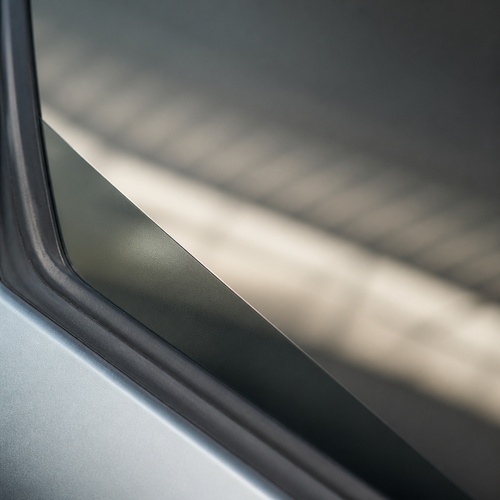
Selecting Film Shade
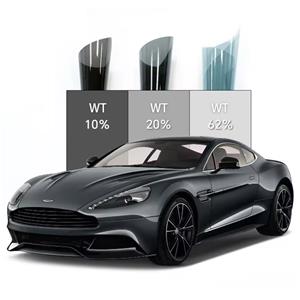
The next consideration is VLT.
A darker film allows less visible light to pass through. A lighter film provides greater transparency.
The choice should account for the original glass. Factory privacy glass can already have a low VLT, so applying dark film over it may create a much darker final result.
Industry guidance in Japan notes that VLT should be considered for the finished glass-and-film combination, especially on driver-related windows.
This is also relevant when selecting car window darkening film for rear windows.
Metallic Car Tint and Appearance
A metallic car tint can create a distinctive appearance by adding reflective characteristics to the window surface.
For a five-window installation, consistency is particularly important because the viewer can see several windows simultaneously.
If the metallic layer varies in optical density across different rolls, the front and rear windows may appear mismatched.
Factory control of coating uniformity is therefore essential.
Published metallic-film data demonstrates that products can be specified using VLT, visible reflectance, solar-energy rejection, UV protection, glare reduction, and infrared measurements.
Aicksn can organize product specifications around these same categories.
Preparing the Glass
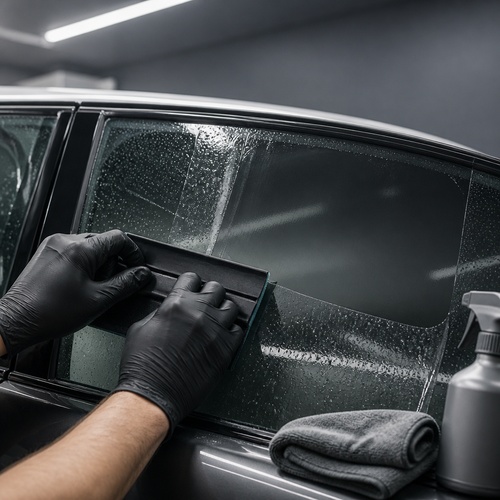
Installation quality begins before the film touches the glass.
The surface should be thoroughly cleaned to remove dust, grease, residue, and other contamination.
Even a high-quality film can show visible defects if particles become trapped between the glass and adhesive.
Professional installation also requires appropriate tools, controlled moisture, and careful edge treatment.
A clean installation environment is particularly important for large windows where small particles can remain visible across a broad surface.
Heat Shaping and Curved Glass
Many rear windows are curved.
Film may need to be heat-shaped before final installation so that it conforms to the glass.
The film's flexibility and dimensional stability influence this process.
JIS S 3107 includes flexibility and dimensional stability among the relevant characteristics of automotive film.
For manufacturers, this means the film should be engineered not only for its appearance but also for practical installation behavior.
Windshield Tint Is Different
A 5-window tint package should not automatically be extended to the windshield.
Windshield tint has separate considerations because it affects the driver's forward field of vision.
In some jurisdictions, minimum VLT requirements are substantially higher for the windshield than for rear glass. Victoria, for example, specifies a minimum 70% VLT for applicable windshields.
Therefore, an installer may use a light windshield tint while applying a darker product to rear windows.
Evaluating Auto Window Film
When purchasing auto window film for professional installation, distributors should examine more than the shade name.
A technical specification should ideally identify:
VLT
visible reflectance
TSER
UV protection
IR measurement
film thickness
roll width
roll length
adhesive type
liner type
test method
Published automotive film data shows why these measurements should be considered separately.
A single "heat rejection" percentage does not describe the complete product.
Factory Quality and Roll Consistency
For a manufacturer, producing a high-quality five-window product means maintaining consistency throughout the roll.
A practical factory inspection program can examine the material at defined intervals.
Optical testing can confirm VLT. Surface inspection can identify scratches or contamination. Dimensional testing can confirm width and thickness. Adhesion testing can verify bonding characteristics.
Finished rolls can then receive batch identification before shipment.
This process gives distributors a traceable connection between the material they purchase and its production inspection record.
Matching Film to the Market
The same film may not be suitable for every market.
Local regulations can address VLT, reflectance, windshield applications, and front-side windows differently. Victoria's official guidance, for example, specifies different VLT thresholds for various window positions and limits visible reflectance to 10% under its applicable requirements.
International distributors therefore benefit from receiving complete product data rather than a generic claim that the film is "legal everywhere."
Aicksn can support export customers by providing technical specifications that allow local installers to make their own compliance determination.
Measuring the Final Installation
The final step is verification.
The installer can inspect the surface for bubbles, contamination, scratches, edge lifting, and visible inconsistencies. Where regulations require VLT measurement, the completed glass should be measured.
This is especially important when factory-tinted glass is involved.
A film specification represents the material under defined test conditions; actual vehicle performance depends on the glass and installation. Published automotive-film documentation likewise notes that performance can vary according to glass type and properties.
For Aicksn, the combination of controlled manufacturing, measurable specifications, batch traceability, and professional installation guidance provides a practical framework for consistent 5-window tint applications.