Auto Window Film: How to Evaluate Film Quality and Durability
Auto window film is exposed to sunlight, temperature changes, moisture, cleaning chemicals, vibration, and repeated environmental cycles. A film that looks attractive when first installed must also maintain its physical and optical properties during vehicle use.
For Aicksn New Materials Technology Co., Ltd., manufacturing quality therefore involves more than producing a consistent shade. It requires control of the film structure, adhesive, surface, dimensions, and optical performance.
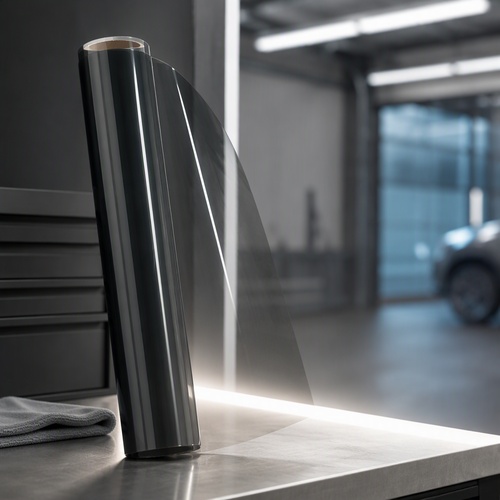
Start With the Film Structure
Automotive film is a multilayer material.
Depending on the product, the structure can include a polyester substrate, dye or metallic layer, protective coating, adhesive, and release liner.
Each layer has a different purpose.
The substrate provides mechanical support. The functional layer creates the optical characteristics. The adhesive attaches the film to glass. The liner protects the adhesive before installation.
A defect in one layer can affect the performance of the finished auto window film.
Optical Consistency
One of the first signs of film quality is optical uniformity.
The film should maintain a consistent shade across the roll without obvious streaks, cloudy areas, or localized changes in reflectivity.
This is particularly important for metallic car tint because variations in the functional layer can change the way light reflects from the surface.
A factory can reduce this risk through process monitoring and multi-point sampling.
Instead of testing only one small piece from the beginning of a roll, production inspection can evaluate representative locations across the material.
VLT and Durability
VLT is an important quality measurement, but durability requires additional testing.
The film should maintain its intended optical properties after exposure to environmental conditions appropriate to its application.
JIS S 3107 identifies weather resistance, dimensional stability, adhesion, transparency, uniformity, and flexibility among relevant automotive film properties.
These characteristics can be translated into factory QC procedures.
For example, a product specification may define an acceptable VLT range, thickness tolerance, width tolerance, appearance grade, and adhesive requirement.
The exact numerical tolerances should be established according to the individual product rather than invented as universal values.
Car Window Darkening Film and Color Stability
Car window darkening film is often selected for its appearance.
If the color changes significantly over time, the customer may perceive the film as poor quality even if it remains attached to the glass.
Color stability is therefore particularly important for dyed constructions.
Metallic products have different aging mechanisms, including potential changes in optical appearance, coating stability, and adhesive behavior.
A professional manufacturer should test the actual product structure under defined aging conditions rather than applying generalized claims.
Solar Performance
Solar performance should also be documented.
Published automotive specifications commonly include TSER, UV protection, glare reduction, visible reflectance, and IR measurements.
A technical sheet from one automotive film series, for example, reports more than 98% UV protection across several listed products and gives separate TSER values for different shades.
These numbers demonstrate how automotive film can be evaluated using multiple performance indicators.
For Aicksn, a similar specification structure can help international buyers compare products.
Adhesive Durability
A film can have excellent optical properties but still fail if the adhesive is unstable.
Potential problems include:
edge lifting
bubbling
peeling
adhesive residue
poor repositioning during installation
loss of adhesion after environmental exposure
JIS S 3107 specifically includes adhesion among automotive film performance considerations.
Factory adhesive control should therefore include both incoming material inspection and finished-product evaluation.
Windshield Tint and Optical Precision
Windshield tint demands particularly strict optical quality because visual defects can become more noticeable in the driver's field of view.
A light windshield product should be evaluated for haze and distortion in addition to VLT.
A film can meet a numerical VLT specification while still being unsuitable for a premium windshield application if its optical clarity is poor.
This is why appearance inspection should accompany instrumental testing.
5-Window Tint Consistency
A 5-window tint package provides another useful example of why consistency matters.
If five windows are installed with the same film, variations in shade or reflectivity can be visible across the vehicle.
The problem becomes more noticeable on metallic film because reflective differences may appear under direct sunlight.
Factory roll consistency therefore affects the final vehicle appearance.
Aicksn can support distributors by maintaining batch identification and recording production inspection data for each shipment.
Auto Window Film and Environmental Exposure
Automotive film experiences repeated temperature changes.
A vehicle can remain in direct sunlight at high temperatures and then be exposed to cold nighttime conditions. Moisture, cleaning, and mechanical contact with window seals add further stress.
A durable product should therefore be designed and tested for the expected automotive environment.
The test method should be documented because accelerated aging results depend on exposure temperature, duration, humidity, radiation intensity, and other variables.
A Factory-Based Approach to Quality
A professional manufacturing workflow can divide quality control into five stages:
1. Raw material inspection: Verify incoming substrates, functional materials, adhesives, and liners.
2. Process control: Monitor coating, drying, lamination, and web-handling parameters.
3. In-process inspection: Check thickness, appearance, and optical characteristics.
4. Finished-roll testing: Verify dimensions, VLT, appearance, adhesion, and required performance.
5. Traceability: Assign batch numbers and retain inspection records.
This approach makes quality measurable at multiple stages.
For distributors comparing auto window film suppliers, the presence of documented testing can be more useful than broad claims such as "premium quality" or "long-lasting."