Windshield Tint: Understanding Visible Light Transmission
Visible Light Transmission, or VLT, is one of the most important measurements in automotive window film. It becomes particularly significant when selecting windshield tint because the windshield is directly involved in forward visibility.
For Aicksn New Materials Technology Co., Ltd., understanding VLT provides a practical foundation for designing, manufacturing, and documenting automotive film products for international markets.

What Is VLT?
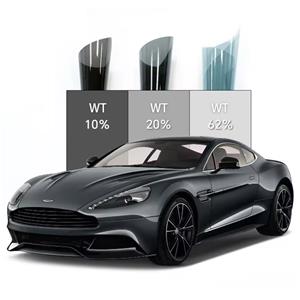
VLT describes the proportion of visible light that passes through a glazing system.
A film with higher VLT allows more visible light through. A film with lower VLT creates a darker appearance.
However, VLT is not determined by the film alone. The original automotive glass also has its own transmission value. When film is applied, the resulting VLT reflects the combined optical behavior of the glass and film.
This is why a product labeled "70%" should not automatically be interpreted as a completed window measuring exactly 70%.
Japanese automotive film guidance specifically states that the relevant value for driver-related windows is measured after the film is installed on the glass.
Why Windshield VLT Matters
The windshield occupies the most important visual position in the vehicle.
A dark rear window may primarily affect rearward visibility, but excessive windshield darkness can directly affect the driver's forward view, particularly at night, during rain, or in poorly illuminated environments.
Regulations therefore tend to be stricter for the windshield than for rear windows.
For example, Victoria's vehicle guidance specifies a minimum 70% VLT for applicable windshields.
Other markets use different requirements, so distributors must check local legislation before recommending windshield tint.
Choosing a Light Windshield Product
A light windshield tint can be designed to provide solar-control characteristics without significantly changing the visual appearance of the vehicle.
The key is to evaluate several properties together:
VLT
optical clarity
visible reflectance
solar-energy rejection
UV protection
infrared performance
adhesive stability
A product with high solar rejection does not necessarily need to be visually dark.
Published automotive film specifications demonstrate that VLT and solar-energy rejection are separate performance parameters.
Metallic Car Tint for Windshield Applications
Metallic car tint can be engineered in lighter shades for applications where a high VLT is required.
However, the metallic construction must be evaluated for reflectance and electronic compatibility as well as solar performance.
A published metallic automotive film technical sheet, for example, provides separate measurements for exterior and interior visible reflectance and notes electronic compatibility for the listed products.
This demonstrates why a manufacturer should evaluate the actual product construction rather than assume that all metallic films behave identically.
Measuring the Finished Glass
Professional installers should use an appropriate VLT meter to measure the final glass when compliance matters.
This is especially important if the original glass is already tinted.
A light windshield film may have a nominally high VLT but still reduce the final glass below a local legal threshold when applied to factory-tinted glazing.
For Aicksn distributors, product labels and technical sheets can clearly state that film VLT is a material specification and that final installed VLT depends on the substrate.
Factory Optical Quality
Windshield products require strong optical quality control.
The film should be inspected for:
haze
scratches
foreign particles
coating variation
bubbles
streaks
color inconsistency
surface defects
JIS S 3107 includes appearance, transparency, uniformity, flexibility, adhesion, dimensional stability, and weather resistance among its automotive film quality considerations.
Aicksn can structure production inspection around these measurable characteristics.
Beyond VLT
VLT should never be treated as the only indicator of quality.
Two films with similar VLT can have different solar rejection, UV protection, reflectance, haze, or adhesive performance.
One published automotive film specification, for example, lists products with similar VLT values but different TSER and glare characteristics depending on construction.
This means buyers should request a complete technical data sheet.
Connecting Windshield Tint With the Rest of the Vehicle
A vehicle may use different film specifications on different glass surfaces.
The windshield may require a very light film. Front side windows may use another VLT. Rear windows may use a darker car window darkening film.
A 5-window tint package can therefore be designed as a combination of compatible products rather than one universal shade.
Auto window film suppliers that offer several VLT levels can provide distributors with greater flexibility.
Aicksn can support this strategy by organizing film specifications around measurable categories, allowing customers to select products according to application.
Production Data for Export Customers
Useful factory documentation can include batch number, nominal VLT, measured VLT, film thickness, roll width, roll length, adhesive type, appearance inspection, and test method.
If a customer orders repeated quantities, batch records can help identify production differences and support quality traceability.
For an international automotive-film manufacturer, this type of documentation transforms product quality from a marketing statement into a measurable process.