Why Factory Quality Matters When Choosing Automotive Wrap Film
When buyers compare automotive film suppliers, the first thing they usually notice is color. Yet color is only one part of film quality.
A reliable PPF wrap, chrome wrap, carbon wrap, matte wrap, or full-body car wrap depends on the consistency of the material beneath the visible surface.
For professional installers and distributors, factory capability can therefore be just as important as the appearance of the final sample.
The Difference Between a Sample and Production
One successful sample does not prove that every roll will behave identically.
Professional customers need repeatability.
If a workshop orders the same matte film three months apart, the color, texture, adhesive behavior, and dimensional characteristics should remain consistent enough for professional use.
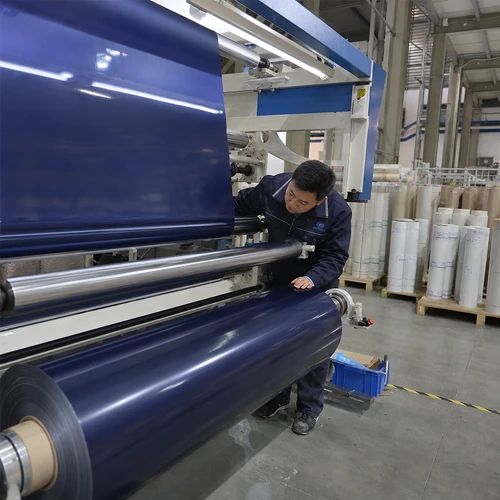
This is why production control matters.
Raw Materials Come First
The manufacturing process begins with material selection.
Different automotive films require different polymer systems, pigments, coatings, adhesives, liners, and surface treatments.
A PPF wrap needs a different performance balance from a chrome wrap.
A carbon-textured film requires pattern and surface consistency.
A matte wrap requires stable low-reflection texture.
Aicksn describes material evaluation as part of its automotive film manufacturing process.
Film Construction
Aicksn's matte black film is described as a five-layer structure:
Scratch-resistant topcoat
Color layer
Reinforced core
Adhesive
Application liner
Each layer contributes a different function.
This illustrates why automotive film should be evaluated as an engineered multilayer product rather than simply a colored sheet.
PPF Wrap Quality
Aicksn's PPF products are described as multilayer systems with high conformability, scratch resistance, stain resistance, UV resistance, chemical resistance, and self-healing characteristics.
These properties depend on the interaction between multiple layers.
A change in one layer can influence the behavior of another.
This is why controlled production is essential for protection-oriented film.
Chrome Wrap Quality
With chrome wrap, optical consistency becomes particularly important.
The reflective surface can make small differences easier to see.
A professional supplier therefore needs to control surface appearance and film uniformity carefully.
Installation also needs to be controlled because reflection can magnify imperfections.
Carbon Wrap Quality
A carbon wrap adds pattern consistency to the quality equation.
If the visual pattern changes unpredictably from one roll to another, installers may struggle to maintain consistent appearance across a vehicle.
Pattern stability is particularly important when several panels are installed next to each other.
Matte Wrap Quality
A matte wrap depends on consistent surface texture.
If one panel has a different level of reflection from another, the finished vehicle can look uneven.
Aicksn's matte black film combines a protective top layer with a reinforced core and adhesive system. The company also describes significant stretch capability for complex vehicle surfaces.
Full-Body Projects Need More Consistency
A full-body car wrap uses many panels.
This increases the importance of batch consistency.
If only one mirror is wrapped, a minor difference may be difficult to notice.
If the hood, roof, doors, fenders, and bumpers all use the same material, consistency becomes much more visible.
Aicksn's Published Factory Data
Aicksn's public product information includes several concrete manufacturing indicators.
The company's color-change film portfolio includes more than 300 colors and finishes. One product is listed in a 1.52 m × 17 m roll format, with large quantities stated as available from stock and delivery of less than seven days.
The company also references ISO 9001 and SGS certification, advanced manufacturing machinery, and a product quality inspection center.
These measurable details provide a stronger basis for supplier evaluation than general statements such as “high quality.”
Quality Inspection
Finished film needs inspection before shipment.
The inspection process should identify surface defects, color variation, roll problems, and other issues that could affect installation.
Aicksn states that its production system includes final quality inspection.
For professional customers, this reduces the likelihood that defects will only be discovered after material reaches the installation bay.
Supply Capability
Manufacturing quality is only useful if the supplier can maintain supply.
Aicksn states that large quantities of selected color-change film products are held in stock and lists delivery times below seven days for the referenced product.
This can be valuable for wrapping studios that need to complete projects according to customer schedules.
Factory Capability and Product Development
Automotive film technology continues to evolve.
Customers increasingly expect better appearance, easier installation, improved surface performance, and more finish choices.
Aicksn's published information emphasizes ongoing automotive film research, manufacturing improvements, and product development.
A factory with both production and development capabilities is better positioned to respond to changing requirements.
How Buyers Should Evaluate a Supplier
When evaluating a film factory, consider:
Material specifications
Layer construction
Manufacturing equipment
Quality inspection
Certification
Roll dimensions
Stock availability
Delivery time
Finish selection
Technical support
Aicksn's published information provides data across these categories.
Choosing the Right Product
Factory quality does not eliminate the need to select the correct technology.
Use PPF wrap for protection.
Use chrome wrap for reflective styling.
Use carbon wrap for technical texture.
Use matte wrap for low-reflection appearance.
Use a full-body car wrap when broad vehicle coverage is required.
The factory's job is to provide stable, technically controlled material so that the installer can achieve the intended result.