Metallic Car Tint: Benefits, Performance, and Appearance
A metallic car tint combines visual styling with a technical approach to solar control. Unlike films selected primarily for color, metallic constructions use reflective materials to interact with solar radiation. For vehicle owners, this can influence cabin comfort, glare, privacy, and exterior appearance. For manufacturers, achieving these properties consistently requires precise control of film structure and optical performance.
What Makes Metallic Film Different?
A conventional dyed film primarily uses colorants to create its appearance. A metallic car tint introduces a metallic component into the film structure. Depending on the construction, this layer can reflect portions of incoming solar energy and alter the film's visible reflectance.
The result can be a distinctive appearance ranging from subtle gray to more reflective finishes. The technical objective, however, is not simply to make the window look shiny. The film needs to maintain optical uniformity while delivering repeatable performance.
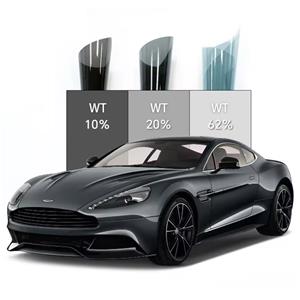
Published technical data for metallic automotive film demonstrates the importance of evaluating several measurements simultaneously. A representative metallic series reports VLT values ranging from very dark shades to lighter options, while UV blocking, solar energy rejection, glare reduction, and infrared performance are separately measured.
This type of specification is valuable for international buyers because it turns a visual product into a measurable engineering product.
Solar Energy and Cabin Comfort
Solar radiation reaching a vehicle includes visible light, infrared radiation, and ultraviolet radiation. A high-quality film can influence how much of this energy enters the cabin.
Total Solar Energy Rejection, or TSER, is one commonly reported measurement. It should not be confused with infrared rejection. Different test methods can produce different numbers, so responsible comparison requires looking at the test method, glass substrate, and measurement range.
One published automotive film specification, for example, reports different TSER values for metallic shades as their VLT changes. This demonstrates a broader principle: darker films can have different solar-control behavior, but darkness itself is not a sufficient measurement of heat performance.
Aicksn can present its metallic car tint products using a similar technical framework, giving buyers access to VLT, reflectance, UV protection, solar rejection, and other relevant specifications.
Appearance Requires Uniformity
Metallic films create another manufacturing challenge: appearance consistency.
If the metallic layer is uneven, the finished film may show differences in reflectivity from one section to another. When installed across large vehicle windows, even a small visual difference can become noticeable.
Factory inspection should therefore examine the complete roll rather than relying on a single sample. Inspection points can be distributed across the width and length of production material. Visual samples can be checked under standardized lighting, while instrumental measurements can verify VLT and reflectance.
For export customers, consistent roll-to-roll appearance is especially important because distributors may install material from different production batches over several months.
Adhesive Performance Matters
The optical layer is only one part of an automotive film. Adhesive performance determines how reliably the material bonds to glass.
A well-designed auto window film should install smoothly without excessive lifting, bubbling, or edge separation when applied under appropriate conditions. The adhesive should remain stable through temperature changes and normal vehicle use.
JIS S 3107 identifies adhesion, dimensional stability, weather resistance, transparency, and other characteristics as relevant automotive film properties. The standard also describes controlled testing of film appearance and visible-light transmission.
These criteria provide useful reference points for a factory quality system.
Metallic Film and Electronics
Modern vehicles contain GPS, mobile communications, satellite radio, keyless entry, and other electronic systems. Some older metallic films were associated with concerns about signal attenuation, which is why manufacturers and installers should examine the specific construction rather than generalizing about every metallic product.
A technical data sheet for one metallic automotive series explicitly states that its tested product will not interfere with cell phones, GPS systems, or satellite radio.
For Aicksn customers, this highlights the importance of testing the actual film construction. If electronic compatibility is a market requirement, it should be evaluated as a product characteristic rather than assumed from the word "metallic."
Building a Professional Metallic Car Tint Product
A factory producing export-oriented film can divide quality control into several stages.
First, incoming raw materials should be checked for specification and consistency. During coating or film formation, process parameters should be controlled to reduce thickness and optical variation. Finished rolls can then undergo dimensional inspection, visual inspection, optical measurement, and adhesive testing.
A production record can include:
Film construction
Nominal thickness
Nominal VLT
Roll width and length
Adhesive type
Release liner specification
Appearance grade
Test date
Batch identification
Such documentation gives distributors more confidence when ordering repeated volumes.
Matching Performance With Market Requirements
Different markets emphasize different characteristics. In regions with intense solar exposure, buyers may focus on solar-energy rejection and UV protection. In urban markets, privacy and glare reduction may receive more attention. In premium automotive applications, optical uniformity and exterior appearance can be equally important.
The best product specification therefore avoids vague phrases such as "maximum heat rejection" without supporting measurements.
Aicksn's metallic car tint can be positioned around measurable performance: controlled shade, consistent optical appearance, stable adhesive behavior, and documented production inspection.
For installers, this also simplifies product selection. Instead of comparing films by appearance alone, they can match the product specification to the vehicle glass, customer requirements, and local regulations.