Car Window Darkening Film: How Shade Levels Affect Driving
Choosing the right car window darkening film is not simply a matter of deciding how dark a vehicle should look. Shade level affects visible light transmission, glare control, privacy, cabin appearance, and—most importantly—how easily the driver can see surrounding traffic. For professional film manufacturers such as Aicksn New Materials Technology Co., Ltd., these factors need to be considered together when developing and producing automotive window film.
Understanding Visible Light Transmission
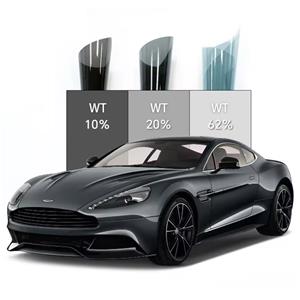
The first specification to examine is Visible Light Transmission, commonly abbreviated as VLT. VLT describes the percentage of visible light that passes through the finished glass-and-film combination. A higher VLT means more visible light enters the cabin, while a lower VLT creates a darker appearance.
A car window darkening film marketed as 70% VLT, for example, should not automatically be expected to produce 70% VLT after installation. The original vehicle glass already has its own optical characteristics. Once film is added, the final VLT depends on both materials.
This distinction is particularly important for windshields and front side windows. Regulations differ between countries, states, and regions, and some jurisdictions specify minimum VLT levels. In the United States, federal glazing requirements have historically emphasized 70% light transmittance for areas necessary for driving visibility. Other markets use their own regulations.
Aicksn can therefore structure product specifications around measurable film properties rather than using darkness as the only selling point. Production inspection can include optical transmission measurements, appearance checks, adhesion evaluation, and dimensional inspection.
Why Different Shade Levels Serve Different Applications
A relatively light film can reduce glare while maintaining a bright cabin. Medium shades provide a balance between privacy and visibility, while darker films create a more dramatic exterior appearance.
The correct selection also depends on the original glass. Many modern vehicles already use privacy glass or factory-tinted glazing. Adding a dark film to such glass can produce a substantially lower final VLT than the film's nominal rating suggests.
For this reason, an auto window film supplier should provide transparent technical specifications instead of describing products only as "light," "medium," or "dark."
The same principle applies to a 5-window tint package. If the rear windows already have dark factory glass while the front windows are relatively clear, applying identical film to every window may not create uniform optical performance.
Metallic Film and Solar Control
A metallic car tint can approach shade control differently from a basic dyed film. Metallic particles or reflective layers can interact with solar radiation, contributing to solar energy rejection and glare reduction.
Published metallic automotive-film specifications illustrate how these characteristics can be measured separately. One technical sheet for a metallic series reports different VLT levels alongside total solar energy rejection, UV blocking, glare reduction, and infrared measurements. For example, certain shades in that series are reported with UV blocking of 99%, while total solar energy rejection varies according to shade.
This demonstrates why buyers should avoid evaluating film quality from darkness alone.
Manufacturing Control Behind Consistent Shade
For a professional factory, consistency is as important as the nominal shade. A production system should control coating or metallization uniformity across the film width and length. Uneven distribution can produce visible shade variation after installation.
A practical quality-control program can include:
VLT measurement at defined sampling points
visual inspection under controlled illumination
film thickness measurement
adhesive-layer inspection
roll-width verification
surface-defect inspection
adhesion testing
aging and environmental testing
Japanese automotive film standard JIS S 3107, for example, addresses transparency, uniformity, flexibility, dimensional stability, adhesion, weather resistance, and other performance characteristics. It also specifies test conditions for visible-light transmission.
These principles provide a useful technical framework for production-oriented automotive film suppliers.
Selecting Film by Vehicle Use
A vehicle used mainly for daytime commuting may prioritize glare control and comfortable visibility. A luxury vehicle may place greater emphasis on privacy and exterior appearance. Commercial vehicles can require different combinations of durability, heat management, and visibility.
The role of car window darkening film therefore extends beyond appearance. A well-engineered product should offer predictable optical behavior across the roll, stable adhesion, clean installation characteristics, and resistance to normal automotive environmental exposure.
For Aicksn, a useful production specification should identify the film structure, nominal VLT, optical performance, roll dimensions, adhesive characteristics, and applicable testing method. This allows distributors and installers to compare products using measurable parameters rather than subjective descriptions.
A production batch can also be documented with batch numbers and inspection records so that distributors can trace the material used for a specific order. Such traceability is particularly useful for international customers purchasing multiple rolls for repeated vehicle applications.
Matching Shade With Safety
A dark appearance does not automatically mean superior performance. Excessive darkness on driver-critical glazing can reduce visibility in low-light conditions. Transport authorities commonly emphasize this issue when regulating automotive tint. Victoria, Australia, for example, specifies minimum VLT requirements for different vehicle windows and notes that tint should not unnecessarily reduce driver vision.
For installers, the practical lesson is straightforward: measure the completed glass rather than relying only on the film label.
That approach also gives Aicksn's customers a clearer basis for selecting film. Instead of asking only "How dark is it?", a buyer can evaluate VLT, solar-energy performance, UV protection, reflectance, adhesion, thickness, and durability as a complete technical profile.