Matte Black Car Wrap: Style, Finish, and Durability
Among modern automotive finishes, the matte black car wrap remains one of the most recognizable. Its appeal comes from controlled light diffusion rather than reflection. Instead of producing mirror-like highlights, the surface absorbs and scatters light, creating a smooth appearance that can make familiar vehicle designs look completely different.
The popularity of matte finishes has also increased the importance of film engineering. A matte surface cannot depend on color alone. Its texture, coating uniformity, flexibility, and resistance to visible surface variation all contribute to the finished appearance.
At Aicksn New Materials Technology Co., Ltd., the development of automotive Vinyl Wraps can be approached through the relationship between material structure and finished appearance. The objective is not simply to produce black film, but to create a stable film system capable of delivering consistent appearance across large panels.
What Makes Matte Black Different?
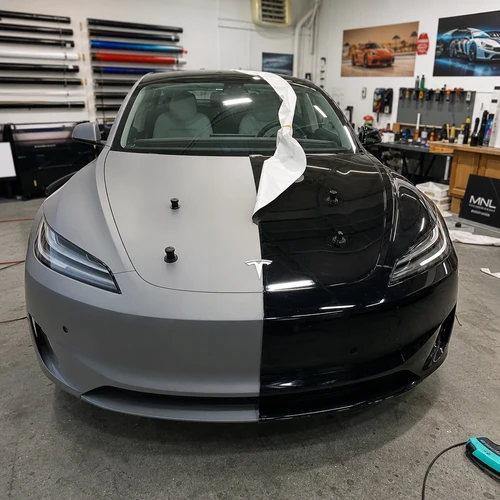
A matte film is designed to reduce direct reflection. On a vehicle hood or door, this produces a softer visual effect than high-gloss paint or film. However, because the surface reflection is deliberately controlled, inconsistencies in texture can become noticeable.
A quality matte black car wrap should therefore maintain consistent surface appearance from the center of the roll to its edges. Variation in coating thickness or surface treatment can result in subtle differences in light diffusion.
This is why production inspection should consider both color and texture. Two films can have the same black color measurement but appear different under strong lighting if their surface structures are inconsistent.
The Role of Film Flexibility
Vehicle bodies contain door handles, bumpers, mirrors, wheel arches, recesses, and compound curves. Automotive films must therefore balance flexibility with dimensional stability.
Cast vinyl is frequently selected for complex vehicle applications because its manufacturing process minimizes internal stress and provides good conformability.
During production, this places emphasis on thickness control and coating uniformity. A film that varies significantly in thickness can behave differently during stretching and heating. For professional installers, predictable behavior is essential because it reduces the risk of wrinkles, excessive distortion, or edge lifting.
Matte Compared With Gloss
The difference between a matte black car wrap and a Gloss Black Vinyl Wrap is not simply “dull versus shiny.” Each finish changes how the vehicle's geometry is perceived.
A Gloss Black Vinyl Wrap produces strong highlights and emphasizes smooth curves. It can visually resemble a deep painted surface when correctly installed and maintained.
A matte finish reduces those highlights and gives the vehicle a more technical or understated character. It can also make panel imperfections less visually obvious in certain lighting conditions, although contamination and physical damage still require proper care.
A Carbon Fiber Vinyl Wrap introduces another dimension through pattern and texture. Rather than relying only on reflectivity, it creates a woven visual effect that is often used on mirrors, roofs, spoilers, dashboards, and accent panels.
A Chrome Vinyl Wrap sits at the opposite end of the visual spectrum. Its reflective surface can create dramatic highlights and requires particularly careful application because surface imperfections are easily visible.
Factory Quality Indicators
For an automotive film manufacturer, product consistency should be measurable. Typical quality-control checkpoints can include raw material verification, pigment dispersion, coating thickness, adhesive coverage, surface inspection, slitting accuracy, and roll packaging.
A production line can also monitor roll length and width to ensure customers receive predictable quantities. For export-oriented manufacturing, standardized roll specifications simplify inventory planning for distributors and installation shops.
The finished film should be visually inspected under controlled lighting. This is especially useful for matte products because small texture variations can be difficult to identify under ordinary warehouse lighting.
Application and Maintenance
Before installing a matte black car wrap, the vehicle surface should be cleaned thoroughly and prepared according to the film manufacturer's recommendations. Contamination beneath the film can create visible imperfections, while excessive stretching can alter surface appearance.
Maintenance should also reflect the characteristics of the finish. Aggressive polishing products designed to increase gloss are generally inappropriate for matte surfaces because they can change the intended visual texture.
The same principle applies to other Vinyl Wraps. A Gloss Black Vinyl Wrap benefits from careful washing that minimizes micro-scratches. A Carbon Fiber Vinyl Wrap should be cleaned without aggressive abrasion, while a Chrome Vinyl Wrap should be handled carefully to preserve its reflective appearance.
For manufacturers, the objective is to provide installers with material that behaves consistently enough to support professional application. For customers, this means the visual result is supported by predictable material performance.
The modern matte black car wrap therefore represents more than a fashionable color. It demonstrates how film formulation, surface engineering, manufacturing control, and application technique work together. With carefully produced Vinyl Wraps, manufacturers can offer matte, gloss, carbon-patterned, and chrome finishes that address different design requirements while maintaining consistent industrial quality.