Carbon Fiber Vinyl Wrap: Style, Texture, and Durability
Automotive design is increasingly influenced by materials that communicate technology. Carbon-fiber-inspired surfaces are a good example. The distinctive woven visual pattern has become closely associated with performance engineering, lightweight construction, and motorsport. Yet replacing conventional vehicle components with actual carbon fiber can be expensive and unnecessary for many styling projects. This is where Carbon Fiber Vinyl Wrap provides an alternative visual solution.
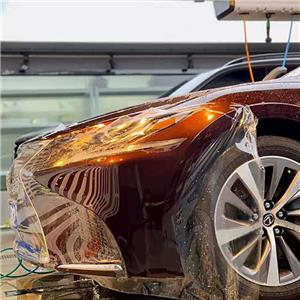
A professionally produced Carbon Fiber Vinyl Wrap can reproduce the recognizable texture and directional pattern associated with carbon-fiber surfaces while maintaining the flexibility expected from automotive film. When integrated into a complete Car Wrap design, it can create contrast between different body sections and make selected components stand out.
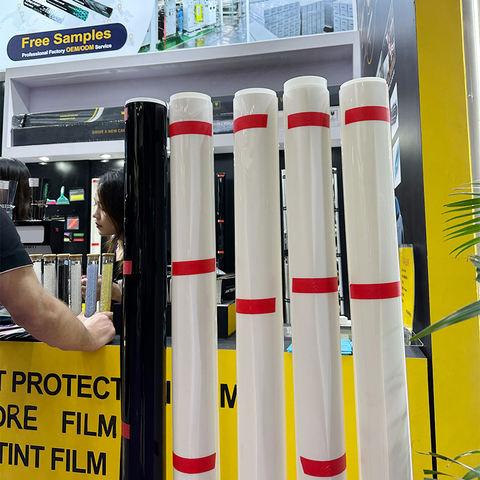
Why Carbon Fiber Effects Remain Popular
The popularity of carbon-fiber styling comes from its ability to communicate performance without requiring an aggressive color. The pattern itself becomes the design feature.
On a sports car, Carbon Fiber Vinyl Wrap can emphasize a hood or roof. On an SUV, it can highlight mirror caps, pillars, spoilers, or trim. On a commercial vehicle, smaller carbon-effect areas can add technical character while keeping the overall design professional.
The material can also be used alongside solid-color films. This creates more visual depth than covering the entire vehicle in a single pattern.
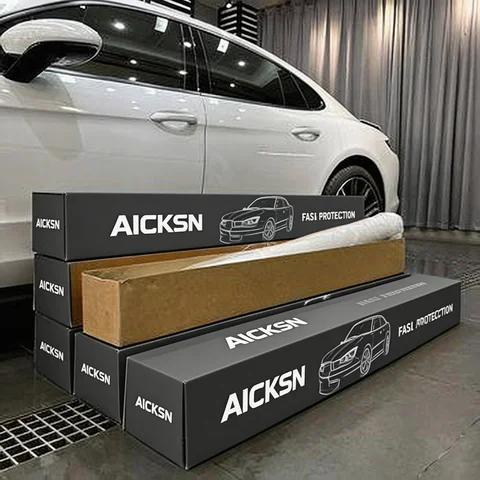
Carbon Fiber Vinyl Wrap and Installation
Patterned film places greater demands on installation technique. With a solid-color Vinyl Wrap, small variations in orientation may be less noticeable. A carbon-fiber pattern, however, has a visible direction.
Installers therefore need to consider pattern alignment, panel transitions, stretch direction, and edge positioning. Excessive stretching can distort the pattern, particularly around deep recesses and complex curves.
The film's flexibility is consequently important. Aicksn's automotive film range is designed for professional installation, and its matte-black product information states that the material can stretch up to three times its original size under specified conditions.
The objective should not be maximum stretching. Instead, installers should use the film's conformability intelligently and maintain the pattern as consistently as possible.
Combining Carbon Fiber with Gloss Black
One of the most effective combinations is Carbon Fiber Vinyl Wrap with a Gloss Black Vinyl Wrap.
Gloss black provides a clean, reflective background, while the carbon-fiber pattern creates localized texture. This combination works especially well on performance vehicles because it produces contrast without introducing a large number of colors.
For example, a vehicle can use gloss black across the main body while applying carbon-fiber-effect film to the roof and mirrors. Another option is to use carbon-effect material on a hood insert while retaining gloss black around the surrounding panels.
The result is a design that appears intentional rather than decorative for its own sake.
Pairing Carbon Fiber with Matte Black
The relationship between Carbon Fiber Vinyl Wrap and Matte Black Vinyl Wrap is equally interesting. Matte black provides a low-reflection background, allowing the carbon pattern to become a subtle visual accent.
This approach is suitable for customers seeking a technical appearance without a highly reflective finish. The combination can be particularly effective on SUVs, performance sedans, and modified vehicles.
The key is controlling contrast. A large number of competing textures can make a vehicle look visually busy. Professional designers often achieve better results by selecting one dominant finish and using carbon-effect material as an accent.
Durability Depends on Film Engineering
Appearance is only one part of carbon-effect film quality. Automotive film must also withstand normal environmental exposure, including sunlight, rain, road dust, temperature variation, and routine cleaning.
Aicksn's automotive-film information describes its products as providing UV protection, scratch resistance, waterproof characteristics, and durable surface performance.
These properties depend on the complete film structure rather than the printed pattern alone. Aicksn describes its matte-black product as a five-layer laminated construction with a protective topcoat, color layer, reinforced core, adhesive, and liner.
This illustrates why professional automotive film should be viewed as a multilayer material system.
Manufacturing Precision Matters
Patterned films require consistent coating and surface processing. Any variation in material thickness, texture, or color can become more noticeable when panels are installed next to one another.
Aicksn's published factory information references advanced manufacturing machinery, a product quality inspection center, ISO 9001 certification, and SGS certification.
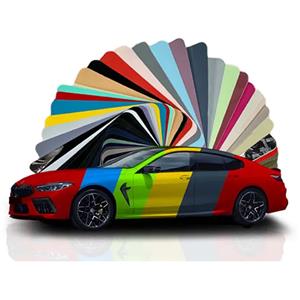
The company also states that its automotive color-change portfolio includes more than 300 colors and finishes. Such a broad product range requires systematic control over different surface and color combinations.
For installers and distributors, production consistency can be just as important as visual variety.
Carbon Fiber for Partial Vehicle Applications
A major advantage of Carbon Fiber Vinyl Wrap is that it does not have to cover the entire vehicle.
Partial applications reduce material requirements and allow designers to focus on high-impact areas. A roof can become a contrasting element. Mirror caps can introduce texture. A spoiler can gain a motorsport-inspired appearance. Interior trim can use carbon-effect film to connect the exterior and cabin design.
This modular approach also allows businesses to provide multiple service levels. Customers can choose between a complete transformation and smaller accent projects.
Aicksn's Supply Capability
A professional installation business needs more than attractive samples. It needs reliable access to material. Aicksn's listed automotive products indicate large quantities in stock, with some products showing delivery of less than seven days.
Aicksn also reports more than a decade of specialization in automotive films and highlights its manufacturing and quality-control infrastructure.
These factors are relevant when evaluating a long-term supplier because installation businesses need predictable material availability and repeatable product characteristics.
Designing a Balanced Carbon-Fiber Finish
The strongest Car Wrap designs use carbon-effect material strategically. The pattern should support the vehicle's shape rather than compete with it.
A Carbon Fiber Vinyl Wrap can provide the technical detail, while a Gloss Black Vinyl Wrap supplies reflection and depth. A Matte Black Vinyl Wrap can reduce visual intensity and create a more understated combination.
The final choice should consider vehicle shape, customer expectations, installation complexity, maintenance requirements, and desired visual identity.
For automotive professionals, the appeal of carbon-fiber film is therefore not simply the pattern. It is the ability to introduce technical styling through a flexible material system. When combined with reliable Vinyl Wrap technology and controlled manufacturing, carbon-fiber effects can become a practical and highly adaptable part of modern vehicle design.